The Jordan Trail
-
Petra
-
Wadi Rum
-
Amman
-
The Dead Sea
Petra
Dana to Petra
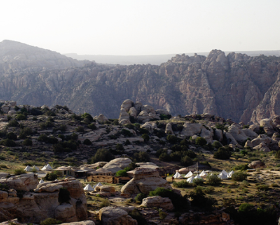
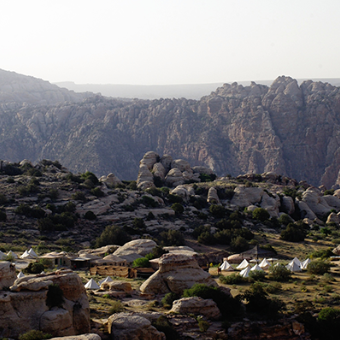
A truly awe-inspiring section of the Jordan Train and named by National Geographic as one of the 15 best hikes in the world. The trail descends the hilltop village of Dana into Wadi Feynan and onto the dramatic mountain plateaus of Wadi Araba. This region crosses several climate zones, diverse ecosystems, hidden canyons, and dramatic labyrinths of hills and valleys displaying the full spectrum of the region’s geology. The scenery spans from majestic and epic mountaintops to peaceful, fertile farmlands with new landscapes presenting themselves every few kilometres. This section’s most dramatic and memorable aspect is the departure at the Nabatean masterpiece, Petra. A chance to enter the city through the ‘back door’ to walk in the footsteps of ancient traders. Few other trails can boast a site as spectacular as Petra.
Total Length: 72.6 KM Days: 4 Hiking days
Main sites in the region:
- Dana Biosphere Reserve
- Feynan ruins and ancient copper mines
- Feynan ecolodge
- Hidden stream and waterfall in Wadi Feid
- Little Petra
- Petra, Nabatean capital and wonder of the world
Petra to Wadi Rum
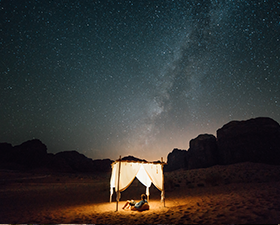
Connecting the two legendary sites of Petra and Wadi Rum is a week-long trek across one of the longest stretches of wilderness on the Jordan Trail. Here in the empty but striking desert, with its dramatic rock formations, stargazing and peace are found at their best. Starting with deep, rugged wadis and moving into open, sandy plains, this section of the trail takes you deep into the places where humans seldom go. Finishing at Wadi Rum village offers a taste of Bedouin life after the remoteness of this section.
Total Length: 125.4 KM Days: 6 Hiking days
Main sites in the region:
- Petra
Jabal Haroun (mountaintop burial place of Aaron, off-route)
- Humeima, ancient and Umayyad ruins
- Sandstone mountain “islands” in a sea of sand
- Wadi Rum, Jabal Rum, and Jabal Um Ishrin
Wadi Rum
Petra to Wadi Rum
Connecting the two legendary sites of Petra and Wadi Rum is a week-long trek across one of the longest stretches of wilderness on the Jordan Trail. Here in the empty but striking desert, with its dramatic rock formations, stargazing and peace are found at their best. Starting with deep, rugged wadis and moving into open, sandy plains, this section of the trail takes you deep into the places where humans seldom go. Finishing at Wadi Rum village offers a taste of Bedouin life after the remoteness of this section.
Total Length: 125.4 KM Days: 6 Hiking days
Main sites in the region:
- Petra
Jabal Haroun (mountaintop burial place of Aaron, off-route)
- Humeima, ancient and Umayyad ruins
- Sandstone mountain “islands” in a sea of sand
- Wadi Rum, Jabal Rum, and Jabal Um Ishrin
Wadi Rum to Aqaba
Leaving Wadi Rum village behind you, the trail passes beneath the towering cliffs of Jabal Rum and Jabal Um Ishrin through the iconic landscape of Wadi Rum – vast, echoing and godlike wrote T.E. Lawrence. Continuing through the magnificent desert landscape, the trail passes the cliffs of Jabal Khazali, Jabal Qattar and weaves between the unique and colorful backdrops of Wadi Rum’s sandstone desert mountains. The trail here follows old shepherd paths, winding its way west across desert wadis and over granite mountains striated with basalt dyke intrusions. At the last pass, the first view of the Red Sea and the Gulf of Aqaba, beyond which lie the mountains of Sinai. The final destination is the warm waters of the Red Sea and the port of Aqaba.
Total Length: 75.9 KM Days: 5 Hiking days
Main sites in the region:
- Wadi Rum (World Heritage site)
- Wadi Rum Bedouin village
- Lawrence’s Spring (Ain Shellaleh) and the Nabataean Temple
- Dramatic desert scenery – sandstone domes and granite and basalt striated mountains,
changing color constantly throughout the day
- Bedouin encampments
- Village of Titen
- Aqaba (Red Sea)
Amman
Ajloun to Iraq Al-Ameer
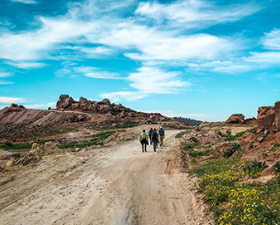
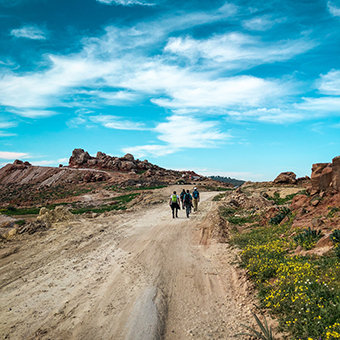
This section weaves through farmland and a spattering of rural villages as you leave Ajloun and its hilltop castle behind. The trail crosses the King Talal Dam, before ascending a hilltop following rich farmlands to the village of Rmeimeen with its beautiful church spire and minaret. Winding down through fertile valleys, the trail reaches the town of Fuhais and continues to Iraq Al-Ameer.
Total Length: 74.3 KM Days: 5 Hiking days
Main sites in the region:
- Khirbet Sarabis and Springs
- King Talal Dam
- Rmeimeen village
- Town of Fuhais
Iraq Al-Ameer to Wadi Zarqa Ma’in
Here you leave the more northern regions and Amman behind and head towards the Dead Sea. Walk past the ancient palace of Iraq Al-Ameer before descending along the spectacular King Hussein’s Rally Road to the Jordan Valley. The climate and scenery changes as the Dead Sea looms from a plateau and Bedouin camps scatter the path. The trail now follows a roman road, encountering basalt cliffs and Wadi Zarqa Ma’in with its year-round stream.
Total Length: 58.8 KM Days: 3 Hiking days
Main sites in the region:
- Fuhais
- Iraq Al-Ameer, Qaser Al Abed and Burial Caves
- Iraq Al-Ameer Women’s Cooperative
- Mount Nebo
- Roman Road
- The Dead Sea canyons of Wadi Zarqa Ma'in and Wadi Wala
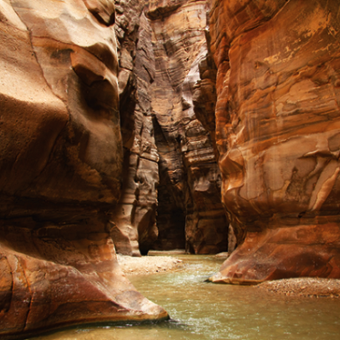
The Dead Sea
Three Wadis to Karak
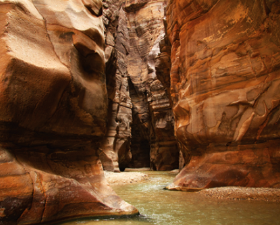
By this point on the trail you encounter some of the spectacular Dead Sea wadis. First, Wadi Mujib, one of the grandest wadis in Jordan, Fertile farmland with rich red soils and Bedouin tents create a dramatic landscape. The ruins of Majdaline lead you to Wadi Ibin Hammad before descending into Wadi el Tawahin. Finally, Wadi ez Zaiyatin takes you to the imposing crusader castle of Karak, impressively situated to overlook the surrounding landscape.
Total Length: 75 KM Days: 4 Hiking days
Main sites in the region:
- Wadi Zarqa Ma'in
- Wadi Hidan
- Wadi Mujib
- Ruins of Majdaline
- Kerak Castle
Discover more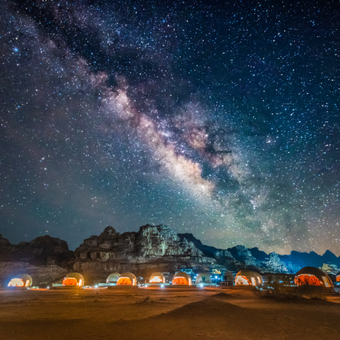
Stargazing in Jordan
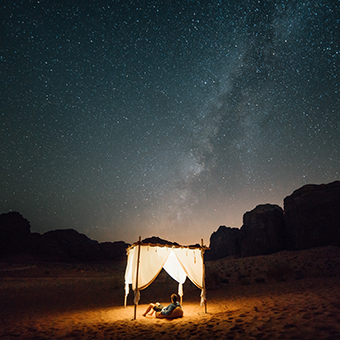
Under Jordan’s vast desert skies, stargazing offers an awe-inspiring experience with some of the clearest views of constellations, planets, and the Milky Way. Wadi Rum, known for its pristine, light-pollution-free environment, provides a perfect setting for observing the cosmos. Guided by local Bedouins, visitors can connect ancient stories to the stars while immersing themselves in the desert's tranquil beauty. Additionally, the Dana Biosphere Reserve, with its elevated landscapes and remote location, offers excellent stargazing conditions, where meteor showers and deep-sky objects come into view. Whether through an overnight camp or a telescope-guided tour, Jordan’s desert and wilderness promise an unforgettable cosmic journey.
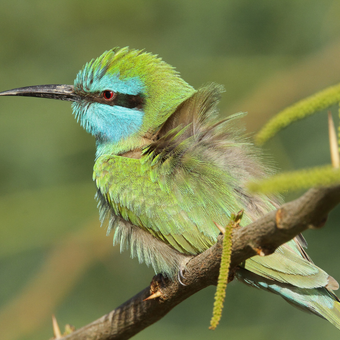
Bird Watching in Jordan
Jordan is an exceptional destination for birdwatching enthusiasts, positioned at the crossroads of Europe, Asia, and Africa. This unique location makes it a crucial migratory corridor, attracting bird species from various regions. With 436 recorded species, Jordan’s diverse landscapes provide unparalleled opportunities to observe rare and migratory birds in their natural habitats. The Azraq Wetland Reserve serves as a vital stopover for herons, eagles, and the elusive hoopoe lark, while the Dana Biosphere Reserve offers breathtaking views of griffon vultures soaring above rugged cliffs. Whether exploring the lush forests of Ajloun or the serene waters of Aqaba, Jordan’s rich biodiversity makes it a hidden gem for birdwatchers.
-
Madaba
-
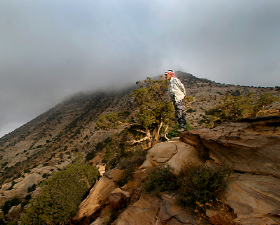
Dana & Feynan
-
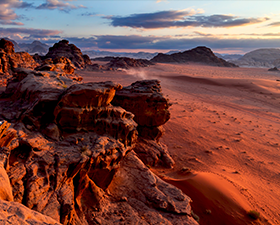
Aqaba
-
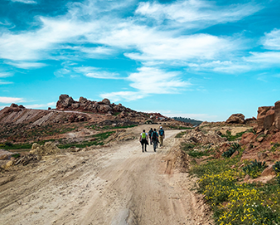
Ajloun
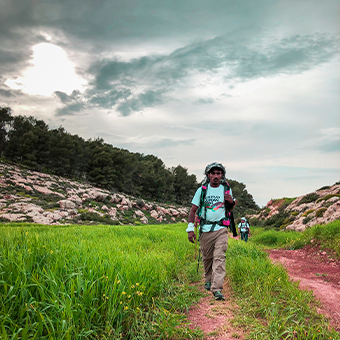
Madaba
Iraq Al-Ameer to Wadi Zarqa Ma’in
Here you leave the more northern regions and Amman behind and head towards the Dead Sea. Walk past the ancient palace of Iraq Al-Ameer before descending along the spectacular King Hussein’s Rally Road to the Jordan Valley. The climate and scenery changes as the Dead Sea looms from a plateau and Bedouin camps scatter the path. The trail now follows a roman road, encountering basalt cliffs and Wadi Zarqa Ma’in with its year-round stream.
Total Length: 58.8 KM Days: 3 Hiking days
Main sites in the region:
- Fuhais
- Iraq Al-Ameer, Qaser Al Abed and Burial Caves
- Iraq Al-Ameer Women’s Cooperative
- Mount Nebo
- Roman Road
- The Dead Sea canyons of Wadi Zarqa Ma'in and Wadi Wala
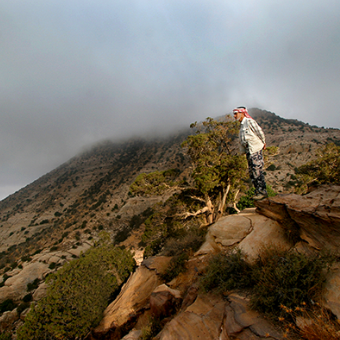
Dana & Feynan
Karak to Dana
The crusader landscape continues in this section as you exit Karak, passing the old crusader village of Shehabieh and the abandoned village of Khirbet Ainun. Orchards and olive groves grow abundantly through fertile plains. Crossing another Dead Sea canyon, Wadi Hasa, the landscape becomes a series of towering limestone cliffs and ridges before reaching Edomite ruins at Sela and Ma’tan. After moving on through the deep Wadi Labun, the trail turns to easier terrain as it passes over the next hill to the restored village of Dana, its hotels and campsite resting on the rim of Wadi Dana at the edge of the Dana Biosphere Reserve.
Total Length: 84.5 KM Days: 5 Hiking days
Main sites in the region:
- Karak Castle
- Khirbet Ainun village
- Tor al Taboun crags
- Wadi Hasa - Burbaita village
- Ma’tan and Buseira and Edomite ruins
- Dana Village and Dana Biosphere Reserve
Dana to Petra
A truly awe-inspiring section of the Jordan Train and named by National Geographic as one of the 15 best hikes in the world. The trail descends the hilltop village of Dana into Wadi Feynan and onto the dramatic mountain plateaus of Wadi Araba. This region crosses several climate zones, diverse ecosystems, hidden canyons, and dramatic labyrinths of hills and valleys displaying the full spectrum of the region’s geology. The scenery spans from majestic and epic mountaintops to peaceful, fertile farmlands with new landscapes presenting themselves every few kilometres. This section’s most dramatic and memorable aspect is the departure at the Nabatean masterpiece, Petra. A chance to enter the city through the ‘back door’ to walk in the footsteps of ancient traders. Few other trails can boast a site as spectacular as Petra.
Total Length: 72.6 KM Days: 4 Hiking days
Main sites in the region:
- Dana Biosphere Reserve
- Feynan ruins and ancient copper mines
- Feynan ecolodge
- Hidden stream and waterfall in Wadi Feid
- Little Petra
- Petra, Nabatean capital and wonder of the world
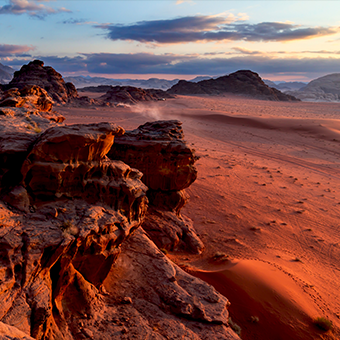
Aqaba
Wadi Rum to Aqaba
Leaving Wadi Rum village behind you, the trail passes beneath the towering cliffs of Jabal Rum and Jabal Um Ishrin through the iconic landscape of Wadi Rum – vast, echoing and godlike wrote T.E. Lawrence. Continuing through the magnificent desert landscape, the trail passes the cliffs of Jabal Khazali, Jabal Qattar and weaves between the unique and colorful backdrops of Wadi Rum’s sandstone desert mountains. The trail here follows old shepherd paths, winding its way west across desert wadis and over granite mountains striated with basalt dyke intrusions. At the last pass, the first view of the Red Sea and the Gulf of Aqaba, beyond which lie the mountains of Sinai. The final destination is the warm waters of the Red Sea and the port of Aqaba.
Total Length: 75.9 KM Days: 5 Hiking days
Main sites in the region:
- Wadi Rum (World Heritage site)
- Wadi Rum Bedouin village
- Lawrence’s Spring (Ain Shellaleh) and the Nabataean Temple
- Dramatic desert scenery – sandstone domes and granite and basalt striated mountains,
changing color constantly throughout the day
- Bedouin encampments
- Village of Titen
- Aqaba (Red Sea)
Discover more
Ajloun
Umm Qais to Ajloun
In the most northern region of the trail, lush, green hills and canyons carry you to ancient Roman sites, over rolling hills, and through oak forests. The diverse and fertile landscape here with its ancient olive trees and hot springs bursts into bloom every spring, with the trees laden with fresh fruit. The villages here are pioneers of community-based tourism with homestays, home-cooked meals, and handicraft stalls adding a true cultural experience to this beautiful northern corner of Jordan.
Total Length: 80 KM Days: 6 Hiking days
Main sites in the region:
- Ruins of Roman Decapolis cities at Umm Qais and Pella
- Ziglab Dam
- Jesus Cave, Beit Idis Church
- Byzantine monastery ruins at Tel Mar Elias, birthplace of the prophet Elijah
- Community tourism and rural scenery in the al-Ayoun village
- Medieval mountaintop site of Ajloun Castle
Ajloun to Iraq Al-Ameer
This section weaves through farmland and a spattering of rural villages as you leave Ajloun and its hilltop castle behind. The trail crosses the King Talal Dam, before ascending a hilltop following rich farmlands to the village of Rmeimeen with its beautiful church spire and minaret. Winding down through fertile valleys, the trail reaches the town of Fuhais and continues to Iraq Al-Ameer.
Total Length: 74.3 KM Days: 5 Hiking days
Main sites in the region:
- Khirbet Sarabis and Springs
- King Talal Dam
- Rmeimeen village
- Town of Fuhais
Stargazing in Jordan
Under Jordan’s vast desert skies, stargazing offers an awe-inspiring experience with some of the clearest views of constellations, planets, and the Milky Way. Wadi Rum, known for its pristine, light-pollution-free environment, provides a perfect setting for observing the cosmos. Guided by local Bedouins, visitors can connect ancient stories to the stars while immersing themselves in the desert's tranquil beauty. Additionally, the Dana Biosphere Reserve, with its elevated landscapes and remote location, offers excellent stargazing conditions, where meteor showers and deep-sky objects come into view. Whether through an overnight camp or a telescope-guided tour, Jordan’s desert and wilderness promise an unforgettable cosmic journey.
Bird Watching in Jordan
Jordan is an exceptional destination for birdwatching enthusiasts, positioned at the crossroads of Europe, Asia, and Africa. This unique location makes it a crucial migratory corridor, attracting bird species from various regions. With 436 recorded species, Jordan’s diverse landscapes provide unparalleled opportunities to observe rare and migratory birds in their natural habitats. The Azraq Wetland Reserve serves as a vital stopover for herons, eagles, and the elusive hoopoe lark, while the Dana Biosphere Reserve offers breathtaking views of griffon vultures soaring above rugged cliffs. Whether exploring the lush forests of Ajloun or the serene waters of Aqaba, Jordan’s rich biodiversity makes it a hidden gem for birdwatchers.
-
Umm Qais
Umm Qais
Umm Qais to Ajloun
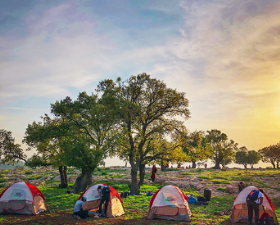
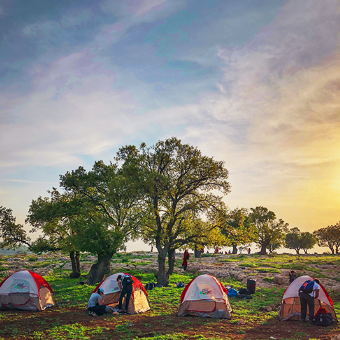
In the most northern region of the trail, lush, green hills and canyons carry you to ancient Roman sites, over rolling hills, and through oak forests. The diverse and fertile landscape here with its ancient olive trees and hot springs bursts into bloom every spring, with the trees laden with fresh fruit. The villages here are pioneers of community-based tourism with homestays, home-cooked meals, and handicraft stalls adding a true cultural experience to this beautiful northern corner of Jordan.
Total Length: 80 KM Days: 6 Hiking days
Main sites in the region:
- Ruins of Roman Decapolis cities at Umm Qais and Pella
- Ziglab Dam
- Jesus Cave, Beit Idis Church
- Byzantine monastery ruins at Tel Mar Elias, birthplace of the prophet Elijah
- Community tourism and rural scenery in the al-Ayoun village
- Medieval mountaintop site of Ajloun Castle
Stargazing in Jordan
Under Jordan’s vast desert skies, stargazing offers an awe-inspiring experience with some of the clearest views of constellations, planets, and the Milky Way. Wadi Rum, known for its pristine, light-pollution-free environment, provides a perfect setting for observing the cosmos. Guided by local Bedouins, visitors can connect ancient stories to the stars while immersing themselves in the desert's tranquil beauty. Additionally, the Dana Biosphere Reserve, with its elevated landscapes and remote location, offers excellent stargazing conditions, where meteor showers and deep-sky objects come into view. Whether through an overnight camp or a telescope-guided tour, Jordan’s desert and wilderness promise an unforgettable cosmic journey.
Bird Watching in Jordan
Jordan is an exceptional destination for birdwatching enthusiasts, positioned at the crossroads of Europe, Asia, and Africa. This unique location makes it a crucial migratory corridor, attracting bird species from various regions. With 436 recorded species, Jordan’s diverse landscapes provide unparalleled opportunities to observe rare and migratory birds in their natural habitats. The Azraq Wetland Reserve serves as a vital stopover for herons, eagles, and the elusive hoopoe lark, while the Dana Biosphere Reserve offers breathtaking views of griffon vultures soaring above rugged cliffs. Whether exploring the lush forests of Ajloun or the serene waters of Aqaba, Jordan’s rich biodiversity makes it a hidden gem for birdwatchers.